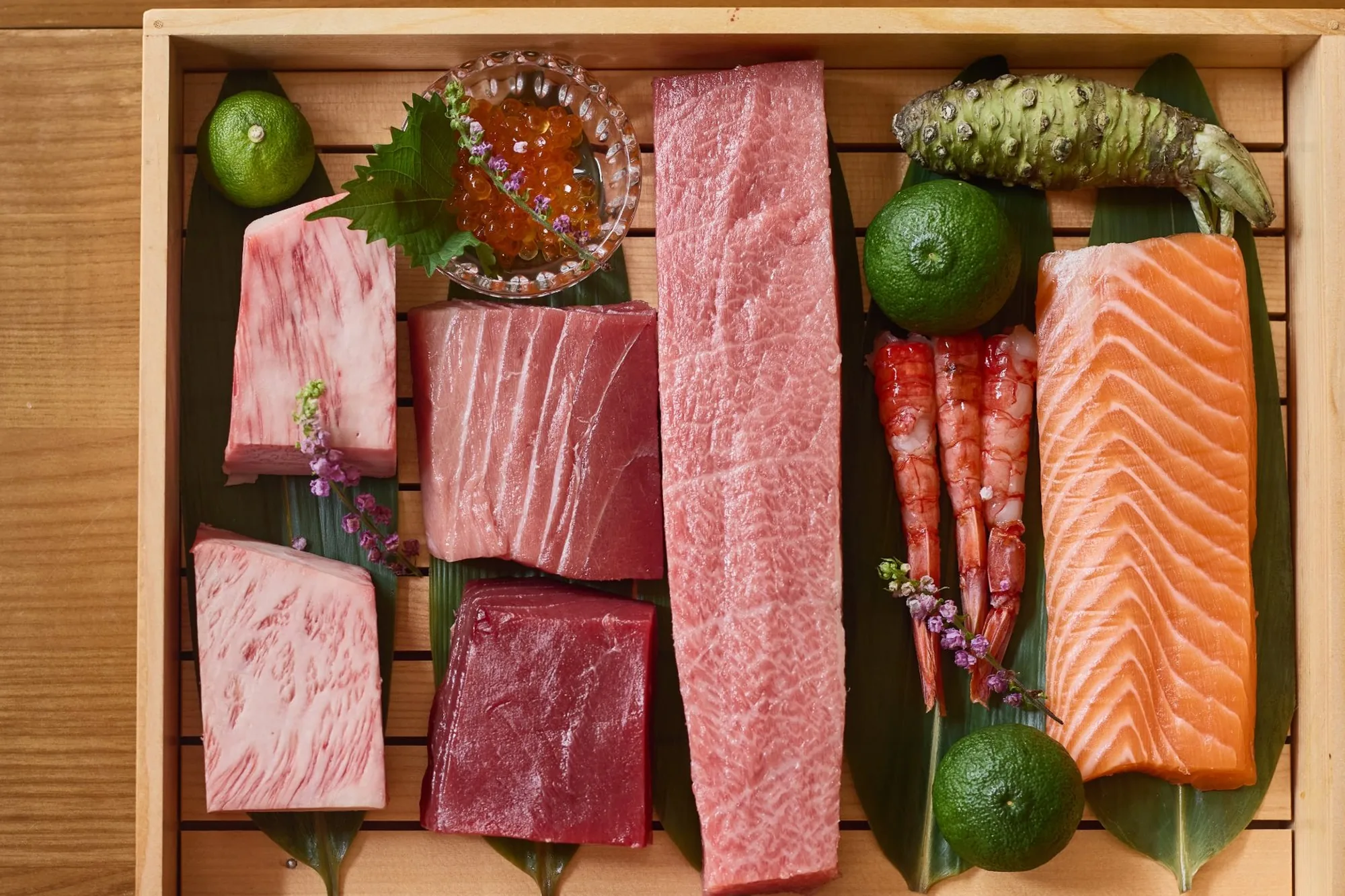
Most of what comes off the Japanese menu at ALBA comes out of the sea. Not all of it. Alongside the foie gras sits the wagyu nigiri: A5 beef, dry-aged in-house and torched just before it reaches you, laid over hand-pressed rice and finished with kizami wasabi, two pieces at a time in the Nigiri Special section. It is the richest mouthful on the menu and, for a lot of guests, the one they talk about afterwards. Here is what it is, what the grade on the label means, and where to find it at an Italian restaurant in Knightsbridge that also runs a Japanese menu and a ten-seat counter, opposite Harrods.
What Is Wagyu, and What Does A5 Mean?
Wagyu means Japanese cattle, and people say "A5 wagyu" without adding the country because there is no need. The word has come to stand for a particular kind of beef: intensely marbled, the fat laced so finely through the muscle that it softens at close to body temperature. That is why a slice of wagyu behaves the way it does on the tongue. The fat does not sit on top of the meat; it is the meat.
The grade has two parts. A letter, A to C, scores how much usable meat the carcass yields. A number, 1 to 5, scores the meat itself: marbling first, then colour, firmness and the quality of the fat. A5 is the top of both scales, the highest yield and the highest marbling the system awards. It is the grade that gets talked about, and the one ALBA serves.
It is also why A5 turns up so often as nigiri rather than steak. Beef this marbled does not want long over heat. A thin slice, warmed for a moment, over a small mound of rice, is the cut at its best.
Why Wagyu Is on the New Japanese Menu
Nigiri is a form, not an ingredient: a hand-pressed finger of seasoned rice with one topping laid over it, eaten in a bite or two at the moment it is made. Fish is the tradition, but the form suits anything that rewards being eaten quickly and simply, and A5 wagyu rewards it more than most. The rice is body-warm, the beef begins to give the moment it meets the rice, and the two arrive in the mouth at the same temperature. There is nothing to cut and nothing to wait for.
If you have eaten the crudo and sashimi at ALBA, the wagyu nigiri is the same thinking applied to beef: find the best of something, do as little to it as possible, and serve it the second it is ready.
Dry-Aged, Then Torched
Two things happen to the beef before it meets the rice. First, it is dry-aged in-house, in ALBA's own dry-ageing cabinet, which concentrates the flavour and takes some of the water out of the meat so the fat reads more clearly. Then, just before serving, each slice is torched: a few seconds of flame across the surface, enough to warm the fat and put a little smoke on it, not enough to cook it through. The centre stays rare and soft. It is the difference between a slice of raw beef and a piece of nigiri.
The Kizami Wasabi
The plate comes finished with kizami wasabi rather than the usual paste, and it is made in-house. Kizami means chopped: wasabi stem, cut fine rather than grated, so it keeps its texture and a cleaner, greener heat. Against beef this rich it does two jobs. It cuts the fat, and it stays distinct in the mouth rather than dissolving into it. There is nothing to add at the table; the piece is dressed and ready when it lands.
Where It Sits on the Menu
The wagyu nigiri is on both the Japanese à la carte and the omakase. On the à la carte, served Tuesday to Saturday at lunch and dinner in the main dining room, it sits in the Nigiri Special section alongside the otoro, the aburi salmon and the hamachi with shiso and uni. Nigiri comes by the pair, so two pieces is the natural portion: enough to register, not so much that it crowds the fish. Most tables open with sashimi, take the wagyu as the richest point of the meal, and finish with something clean.
At the ten-seat counter, it arrives as part of the chef's sequence, with dinner seatings at 6:30pm and 8:30pm, Tuesday to Saturday. If the word is new to you, our guide to what omakase is covers it. Either way, the current menus are on the website, and the team will tell you what is on when you book.
Frequently Asked Questions
What Is A5 Wagyu?
The highest grade in the Japanese beef grading system: A for the top yield score, 5 for the top marbling and quality score. It is the most heavily marbled beef the system recognises.
Is Wagyu Nigiri Cooked?
Lightly. At ALBA the beef is dry-aged in-house, then torched for a few seconds just before serving, so the fat softens and the surface takes a little smoke while the centre stays rare.
What Is Kizami Wasabi?
Finely chopped wasabi stem rather than grated paste, made in-house at ALBA. It has a cleaner, greener heat and keeps its texture, which suits rich beef.
Is Wagyu Nigiri on the Omakase Menu?
Yes. It is on both the omakase and the Japanese à la carte. The current menus are on the website.
Where Can I Order Wagyu Nigiri in Knightsbridge?
At ALBA, 70 Brompton Road, directly opposite Harrods: from the Japanese à la carte in the dining room, Tuesday to Saturday at lunch and dinner, or at the omakase counter.
